

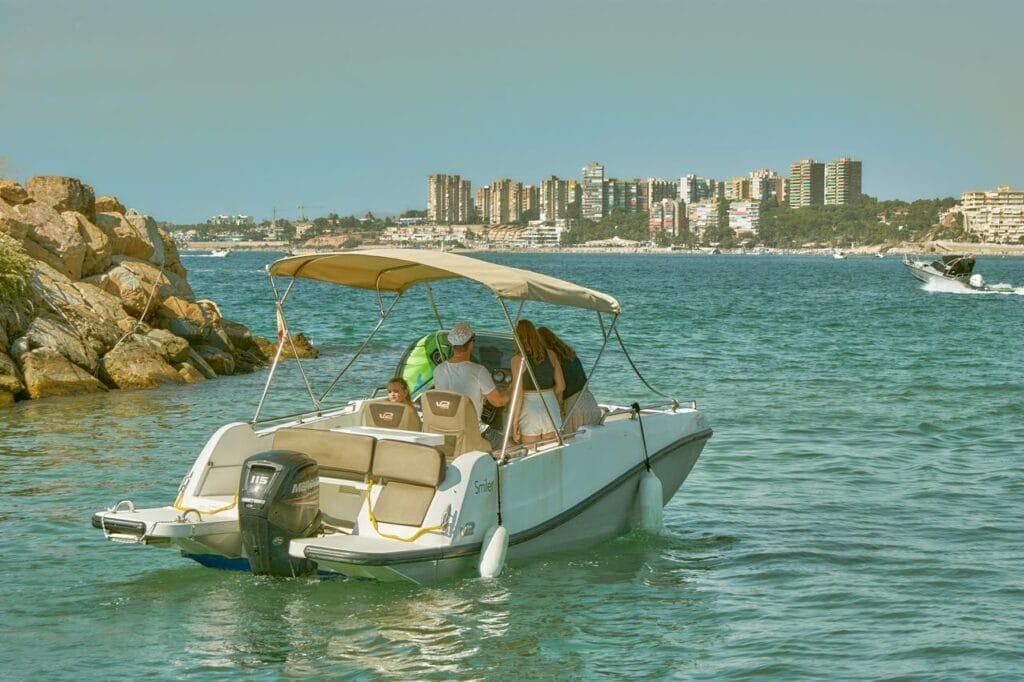

The Balearic Islands sit in the western Mediterranean at the convergence of Spanish, Catalan, and maritime influences that make this corner of Europe worth approaching from the water. Mallorca is the obvious entry point — largest island, most developed marina infrastructure, widest choice of departure bases — but the archipelago’s character is better understood once you spread out across the smaller islands nearby. A week that begins at anchor in a Mallorcan cala and ends anchored off an uninhabited Menorcan beach is a fundamentally different experience from either island alone.
Summer runs from late May through early October, with reliable tramontana and garbí winds, water temperatures above 25°C from July onward, and daylight that stretches past nine in the evening. This guide covers Mallorca and four more island destinations worth building a summer itinerary around.
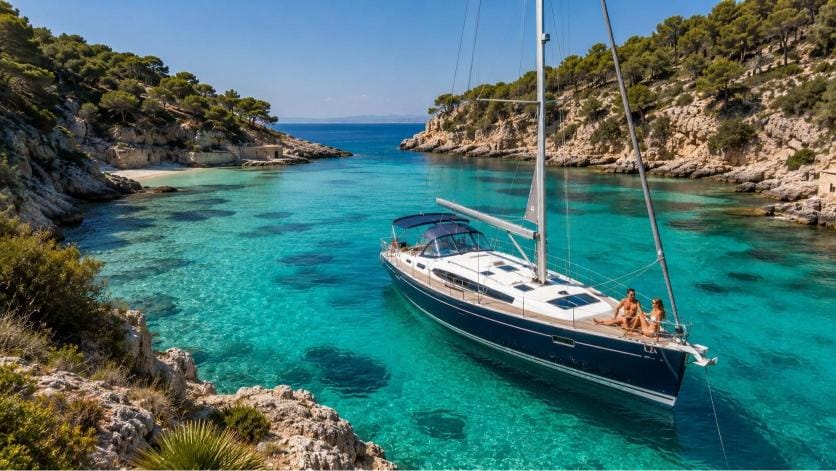
Hire a Boat in Mallorca: Calas, Bases, and Coastal Routes
Mallorca’s coastline runs for more than 550 kilometres and takes in cliff faces, pine-backed anchorages, and fishing villages that most visitors never reach by road. The main charter infrastructure sits in the southwest: Real Club Náutico de Palma and Club de Mar in Palma Bay handle the bulk of departures, while the southeast corner — Porto Colom, Porto Cristo — offers quieter bases for sailors who want to start closer to the east coast calas.
The prevailing summer pattern runs tramontana from the northwest in the morning, shifting to garbí from the southwest by early afternoon. Most itineraries follow a clockwise circuit: north from Palma along the Tramuntana coast past Cap de Formentor, then south down the calmer east coast through Cala Mondragó, Cala Figuera, and Cala Llombards before a final leg through the Cabrera Archipelago — a national park where anchoring is permitted in designated bays — back to Palma.
The east coast is where the hidden calas are. Cala Varques requires a short walk from the nearest track and stays quiet through the morning. Cala Bota, beside a 16th-century watchtower, is accessible by sea but awkward to reach overland. Both have clear water over limestone sand and are sheltered from the afternoon chop. Midweek in early July these anchorages are rarely crowded before noon.
Charter weeks typically run Saturday to Saturday from Palma, though some bases offer mid-week availability. To hire a boat in Mallorca and compare currently available models and departure dates, the booking platform lists live inventory for this summer.
Menorca: The Quieter Balearic and Its North-Coast Anchorages
Menorca sits 40 kilometres northeast of Mallorca and operates at a different pace. The island has no mass-market resort strip on the scale of southern Mallorca or Ibiza Town, and its 2016 Biosphere Reserve status has reinforced planning restrictions that keep development low-rise and low-density. For sailors this translates into anchorages that remain genuinely quiet even in August.
The north coast faces the tramontana directly and is rougher, more dramatic, and largely inaccessible overland. The south coast has the island’s best anchorages: Cala Turqueta, Cala Macarella, and Cala en Turqueta are accessible by sea but require a half-hour walk if you arrive by land, which limits crowds to the morning window. Cala Galdana has a marina and is more developed; it works as a fuel and provisioning stop.
The capital, Maó (Mahon), sits at the end of a natural harbour that runs four kilometres inland — one of the deepest natural ports in the Mediterranean. The harbour itself is worth motoring up slowly: 18th-century British fortifications on both banks, traditional wooden boats moored against limestone quays, and the Museu de Menorca in a former Augustinian convent with a solid collection covering the island’s Bronze Age settlement.
Ciutadella on the west coast is the older capital and more atmospheric for an evening stop, with a Gothic cathedral, a tangle of pedestrian lanes, and restaurants along the old port wall that serve local lobster stew (caldereta de llagosta) at prices that reflect the effort of getting here.
Ibiza: Anchorages Beyond the Headline Reputation
Ibiza gets defined almost entirely by its nightlife in most travel coverage, which undersells what the island actually looks like from the water. The western and northern coasts have cliff-backed anchorages, pine forests running down to the sea, and small beaches that the beach club infrastructure hasn’t reached. Cala d’en Serra in the north is one of the better examples: a narrow inlet with a collapsed pier and minimal facilities, reachable by boat in 20 minutes from Portinatx and by a 45-minute walk from the nearest road. You can rent a yacht in Ibiza also here.
Es Vedrà, a 382-metre rock stack off the southwest coast, is the island’s most photographed feature and best seen at anchor in the adjacent bay of Cala d’Hort in the late afternoon when the light catches the rock from the west. The bay has a couple of restaurants on the beach and a mooring field that fills by midday in July.
Ibiza Town (Eivissa) is the most practical base for provisioning and for exploring the fortified old city, Dalt Vila, which is a UNESCO site with walls dating to the 16th century. The views from the upper ramparts over the port and the salt flats to the south are among the better urban panoramas in the western Mediterranean.
Sailing distances from Mallorca are manageable: Ibiza Town is roughly 80 nautical miles from Palma, typically a one-day passage if you leave early.
Formentera: The Flattest Island and the Clearest Water
Formentera is 20 minutes by fast ferry from Ibiza and reachable by sailing boat in under two hours from San Antonio on Ibiza’s west coast. It is the smallest of the main Balearic islands — 20 kilometres end to end — essentially flat, and bordered by water that is consistently cited among the clearest in the Mediterranean. The colour runs from turquoise over the sand banks of Ses Illetes to deep blue where the seabed drops away south of the main island.
The mooring area off Ses Illetes is a busy natural harbour in summer, with the protected status of the Parc Natural de Ses Salines limiting motorised access close to the sandbar. Anchor in designated areas, approach by dinghy, and you have one of the better beaches in the Mediterranean at walking distance — a narrow strip of white sand with no infrastructure beyond a few sun lounger rentals.
The island has one town (Sant Francesc Xavier), one main road, and almost no nightlife by Ibiza standards. This is by design; Formentera’s appeal is specifically the absence of what Ibiza offers. Cycling is the default way to get around on land — the road distances are short, the terrain is flat, and the hire shops in the port are well stocked.
Cabrera: Sailing into a National Park
Cabrera is an archipelago of 19 islands and islets 15 kilometres south of Mallorca’s Cape Salinas, and the entire grouping has been a national park since 1991. Private vessel access is permitted with a prior authorisation — issued by the park authority — and the anchorage in the main bay, Port de Cabrera, is one of the more unusual overnight stops in the western Mediterranean: a natural harbour with a Moorish castle on the promontory, no permanent residents, strict limits on the number of visiting boats, and water so clear that the anchor chain is visible at eight metres depth.
The park was the site of a French prisoner-of-war camp during the Napoleonic Wars, and the castle houses a small museum covering that history. There are marked walking trails through the garrigue and pine scrub of the main island, and snorkelling around the outlying islets encounters marine life that is noticeably more abundant than in unprotected areas.
Authorisations for overnight anchoring must be requested in advance — the park authority allocates a fixed number of permits per day, and July and August fill quickly. Day visits without overnight anchoring require no permit but are limited by boat size.
The Balearics reward methodical planning more than spontaneous arrival. Berths in Palma fill early, Cabrera permits go fast, and the east-coast calas of Mallorca are visited by the first boats before 9am in high season. The core itinerary — Mallorca east coast, Formentera, Cabrera — covers the range from sheltered family cala to open Mediterranean crossing within a standard week and leaves room for weather adjustments without significantly changing the character of the trip.